

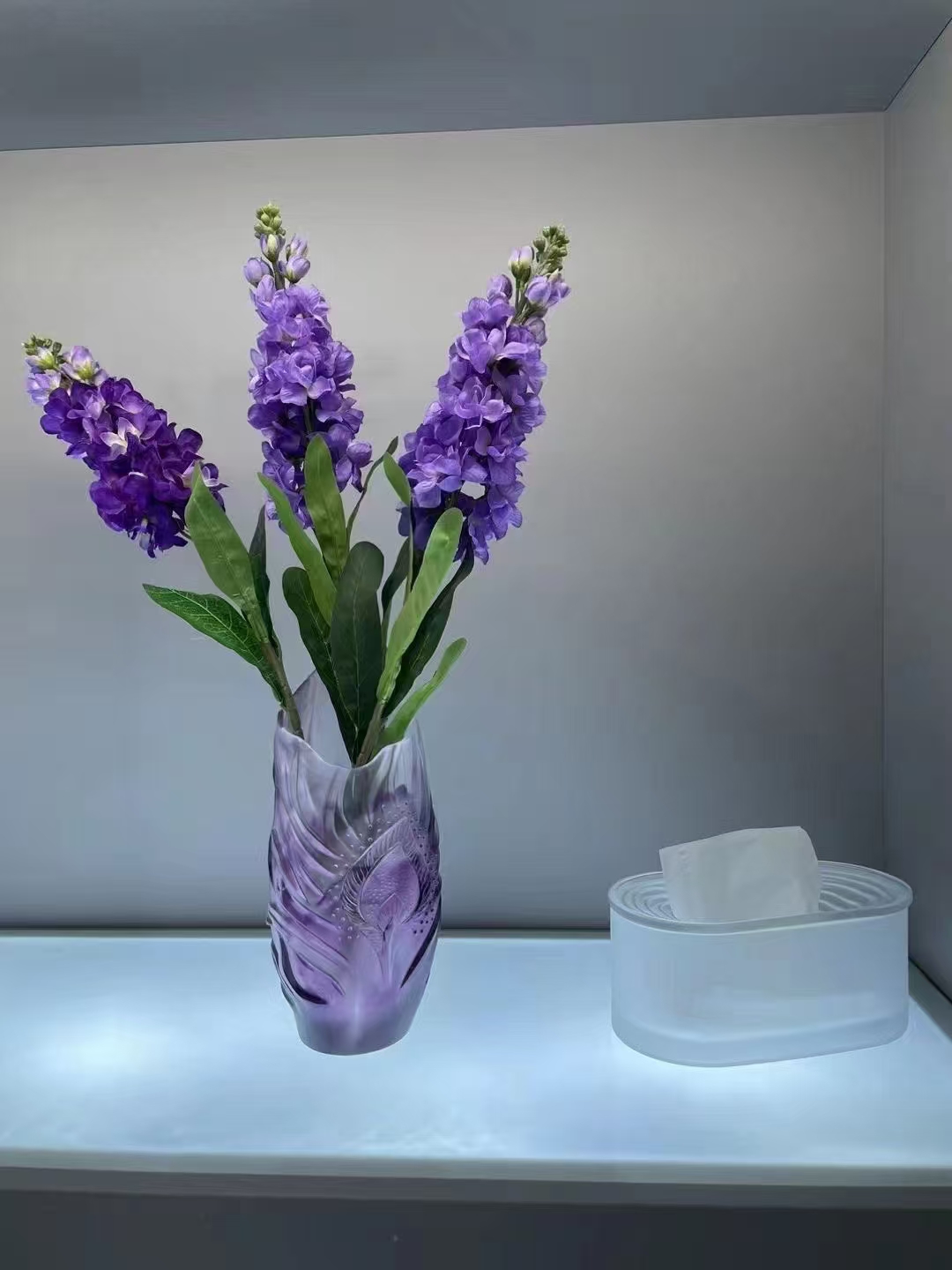
Every lifestyle or gift store owner knows this feeling: the art glass shelf looks beautiful, customers stop, they take photos… but only some pieces actually move.
From the outside, art glass home decor looks like a pure aesthetic decision. From the inside, it is a mix of formats, color choices, pricing logic, display strategy and supplier reliability. This article takes a practical, factory-side view on what we consistently see selling in high-end lifestyle and gift stores around the world.
Section 1 – Small, giftable pieces do most of the work
In most stores, the true volume comes from small, giftable objects rather than large statement sculptures.
What typically sells best:
– Small figurines and abstract objects
– Compact vases and vessels
– Paperweights and desk sculptures
– Tealight and candle holders
Why these formats win:
– They fit classic gift budgets for birthdays, housewarmings and “just because” purchases.
– They do not require much display space or storage.
– Customers can immediately imagine who they would gift them to.
Large statement pieces remain important for image, storytelling and a few high-value sales. But the everyday engine of the category is almost always the small, easy-to-gift object.
Section 2 – Calm, layered colors outperform loud trends
Social media feeds are full of intense, saturated colors. Sales data is usually quieter.
Colors that tend to perform well across seasons and styles include:
– Clear glass with internal bubbles, veils or gentle texture
– Warm neutrals: smoke, tea, soft amber, champagne tones
– Calm jewel tones: deep blue, forest green, amethyst
These palettes sit comfortably inside modern, Scandinavian and “quiet luxury” interiors, which continue to dominate home decor inspiration globally.Times Union
Bolder, experimental colors can be used as a small capsule or limited run, but building the entire category on very loud tones often increases risk and slows repeat sales.
Section 3 – Soft, tactile forms make buying feel safe
Most customers cannot name design languages, but they respond immediately to how an object feels in the hand.
Pieces that sell reliably tend to share these traits:
– Rounded edges instead of very sharp, fragile-looking points
– A comfortable weight that feels solid but not heavy
– A stable base that sits confidently on shelves, tables or consoles
If customers are afraid to pick a piece up, they are less likely to take it to the counter. The safer and more satisfying the tactile experience, the easier it is for staff to recommend the piece and for customers to imagine living with it.
Section 4 – A clear price ladder builds trust
In art glass decor, the question is not only “Is this price high or low?” but “Does this price structure make sense?”
A healthy price ladder in high-end lifestyle and gift stores often looks like:
– Entry level
Simple small pieces at accessible price points, ideal for first-time buyers and impulse gifting.
– Middle tier
More complex shapes, color work or finishes, clearly justifying the higher price.
– Anchor pieces
A few larger or more intricate works that carry brand image and signal premium value.
When each step feels logical, customers can move up or down the ladder without confusion. Without this logic, everything risks feeling expensive and hard to compare, which slows decisions.
Section 5 – Display art glass as a story, not as stock
The same item can feel ordinary or special depending on how it is shown.
Stores that consistently succeed with art glass tend to:
– Create small feature “islands” where glass is the hero, not an afterthought.
– Use levels – risers, books, stands – instead of one flat line.
– Group 3–5 related pieces by color, theme or occasion (for example, “calm neutrals for living rooms” or “small desk pieces under a set budget”).
– Pay close attention to light, using natural or focused lighting so the glass can actually catch and shape the light.
A simple benchmark: if customers often stop to take photos of the display, the story is working.
Section 6 – Glass versus resin: choosing the right material mix
From the production side, glass and resin each have clear strengths.
Glass or glass-like materials are ideal for:
– Smaller, high-perceived-value gift pieces
– Objects where clarity, sparkle and refraction matter most
– Situations where weight and cool touch are part of the luxury feel
Resin is often better for:
– Larger, sculptural forms where glass would be too heavy or fragile
– Pieces that require complex shapes or fine detailing at a more accessible cost
– Projects where impact resistance, shipping risk and display handling are major concerns
In practice, many successful stores adopt a mixed strategy: glass for “jewelry-like” objects, resin for larger, bolder shapes. As long as finishes are coherent and staff can explain the difference in simple language, customers are usually very comfortable with both.
Section 7 – Packaging and story cards quietly lift perceived value
For giftable decor, packaging is part of the product.
Well-designed packaging for art glass home decor usually includes:
– A rigid box with a fitted insert to hold the piece securely.
– Calm branding that supports, rather than competes with, the object.
– A short story card explaining how the piece is made, what inspired it and basic care instructions.
This combination reduces breakage and returns while giving staff a simple narrative to use at the counter. For corporate gifts and awards, it also makes the experience feel intentional rather than generic.
Section 8 – Why working with a studio–factory partner matters
Most retailers, designers and agencies do not want to become manufacturing experts. They want to work with a partner that understands both the creative intent and the constraints of production, shipping and retail display.
A strong studio–factory partner can help:
– Translate moodboards and sketches into manufacturable shapes, sizes and colorways.
– Recommend formats and price ladders that match the store’s positioning and audience.
– Develop and test packing solutions for global shipping and retail handling.
– Maintain molds, tools, color recipes and specifications for repeat orders and capsule series.
This turns beautiful one-off pieces into a repeatable, profitable art glass decor category that can grow over time.
FAQ – Common Questions from Lifestyle and Gift Stores
Q: What price points work best for small art glass decor in high-end gift stores?
A: It depends on the market, but most stores perform best with a clear entry range for simple pieces, a mid-range for more complex work, and a small selection of premium anchors. Customers need to feel that each step is justified by design, size or craftsmanship.
Q: Are bold or unusual colors worth the risk in art glass decor?
A: They can be, but usually in controlled capsules or limited runs. Calm neutrals and refined jewel tones tend to deliver more stable, long-term sales, while bold colors are better for seasonal campaigns or small, attention-grabbing pieces.
Q: How many art glass SKUs should a lifestyle store carry to test the category?
A: Many retailers start with a focused edit: a handful of entry-level pieces, a few mid-tier designs and one or two anchor pieces. The key is to cover different budgets without overwhelming the shelf.
Q: What minimum order quantity (MOQ) is typical for custom glass decor from a factory in China?
A: MOQs vary by process and complexity, but for small art glass or glass-like objects, many studio–factories work with tiered MOQs for standard designs and higher MOQs for fully custom shapes, colors or packaging. It is important to ask for realistic MOQ ranges during early discussions.
Q: How can a retailer reduce risk when trying a new art glass supplier?
A: Practical steps include starting with a smaller, well-defined capsule, agreeing on clear samples and approval steps, stress-testing packing methods and aligning on lead times and replenishment. Working with a factory that has experience in global shipping and store-ready packing reduces surprises.
Structured Facts – For Buyers and Sourcing Teams
Topic: Art glass home decor performance in lifestyle and gift stores
Key Insight: Small, giftable pieces in calm colors drive most volume and repeat sales.
Formats: Figurines, compact vases, tealight holders, paperweights, desk objects
Color Direction: Clear glass, warm neutrals, calm jewel tones
Form Language: Soft edges, tactile forms, stable bases
Price Strategy: Clear entry, middle and anchor tiers with logical steps
Material Mix: Glass or glass-like materials for small premium pieces; resin for larger sculptural work
Display Approach: Small story islands, grouped pieces, layered heights, good lighting
Packaging: Rigid boxes, fitted inserts, calm branding, story cards
Lead Time: Typically negotiated by project; sampling and packing tests strongly recommended
Application Area: Lifestyle stores, gift retailers, interior design projects, corporate gifts and awards
Conclusion
Art glass home decor will probably never be the cheapest category in your store. It does not need to be. When the formats, colors, price ladders, display and supplier partnership are intentional, art glass becomes a quiet profit engine and a powerful part of your brand image.
For retailers, designers and agencies, the next step is often simple: review your current glass or glass-like shelf, test one or two of these patterns, and measure how quickly the right pieces start to move.